
Patients Summary
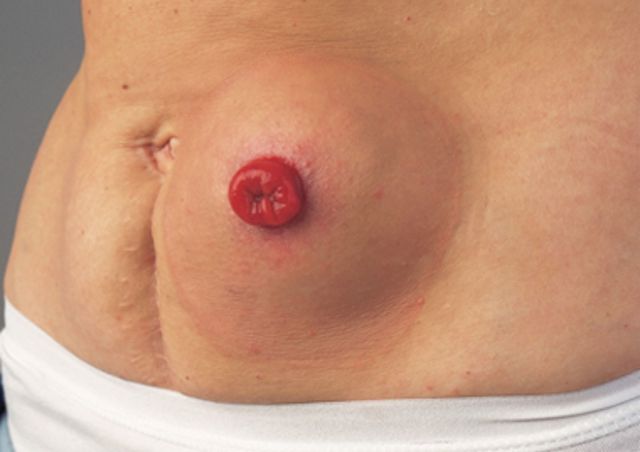
Parastomal hernia is a common complication of stomas. ( Surgically formed opening in the bowel which allows food waste to come out of the body) it occurs when the content inside your tummy ( Bowels and fat) bulges out through a weak point underneath the skin close to your stoma.
You may notice this as a bulge beside your stoma, which becomes more prominent during coughing. These are painless but sometimes can cause discomfort. Parastomal hernias can interfere with the proper application of stoma bags and lead to leakage.
Most parastomal hernias are asymptomatic. But sometimes, it can cause blockage of your bowel, which needs an immediate operation. When this occurs, your stoma drainage will stop, your tummy swells up, and you may get pain and start vomiting. You should see a doctor immediately.
If the parastomal hernia doesn’t bother you, it can be left alone. If symptomatic, they are treated with the closure of the stoma, repositioning the stoma, or repairing the stoma.
For more advanced details, continue reading.
What is parastomal hernia
Parastomal hernia is the protrusion of content (Intestine, Omentum, Fat) of the abdominal cavity through a defect ( weakness) in the abdominal wall adjacent to a Stoma. The defect usually creates at the time of the initial surgery for the creation of the stoma. This is contributed by weak abdominal wall muscles. This manifests as a palpable defect or as a lump that increases in size during coughing or straining.
Incidence of parastomal hernia
Parastomal hernias are extremely common. Even with the perfect surgical technique, patients can develop parastomal hernias without any warning. Scientific studies have shown an incidence rate of up to 48% of all patients having stomas.
What contributes to parastomal hernias
- Type of stoma
Patients with Colostomies have a higher chance of getting parastomal hernias compared to ileostomies. And end stomas get more hernias compared to loop stomas. End colostomies have the highest risk for parastomal hernias, and Loop ileostomies have the lowest risk. - Surgical technique
Trephine Stomas and stomas created laparoscopically have a lower risk for parastomal hernias. - Advanced aged
Elderly patients have a higher risk compared to young, fit individuals - Other Risk factors
Technical failure, obesity, malnutrition, post-operative wound infections, emphysema, cancer, smoking, constipation
Complications of parastomal hernia
Most Parastomal hernias remain asymptomatic. However, researches have shown complication rates varying from 11-70 percent’s.commen complications includes
Bowel obstruction (blockage of the small or large bowel)
Incarceration (Content which is comping out through the hernia defect remain outside due to adhesions.
Prolapse – sometimes, hernia leads to stoma prolapse
Pain and discomfort
Appliance leakage – this one of the commonest problems caused by parastomal hernias. Due to the bulge of the hernia, patients cannot fix the stoma bag properly, leading to leakage.
Types of Parastomal hernias
Different classification systems exist for parastomal hernias. Devlin Classified them into four groups.
Type 1 – Interstitial hernia
Type 2- Subcutaneous hernia
Type 3 – Intrastomal Hernia
Type 4 – peristomal hernia
Treatment of Parastomal hernia
If asymptomatic, parastomal hernias can be managed conservatively. Symptomatic parastomal hernias warrant active treatment.
The treatment method depends on whether it is a permanent stoma or not. Temporarily stoma, which has already served its function, can be reversed with hernia repair, which gives a permanent solution.
Permanent stomas are treated with Either stoma repair or stoma relocation. But stoma relocation gives a less satisfactory result as it can complicate the situation by further weakening the abdominal muscles.
Surgical techniques for Parastomal hernia repair.
These may be repaired by open surgical method or laparoscopically. One of the following surgical techniques can be used.
- Sugar baker
- Keyhole
- Sandwich mesh
- Fascial repair.
How to prevent Parastomal hernia
Usage of prophylactic mesh has been shown to reduce parastomal hernia formation.

Pingback: Total Mesorectal excision - My Blog